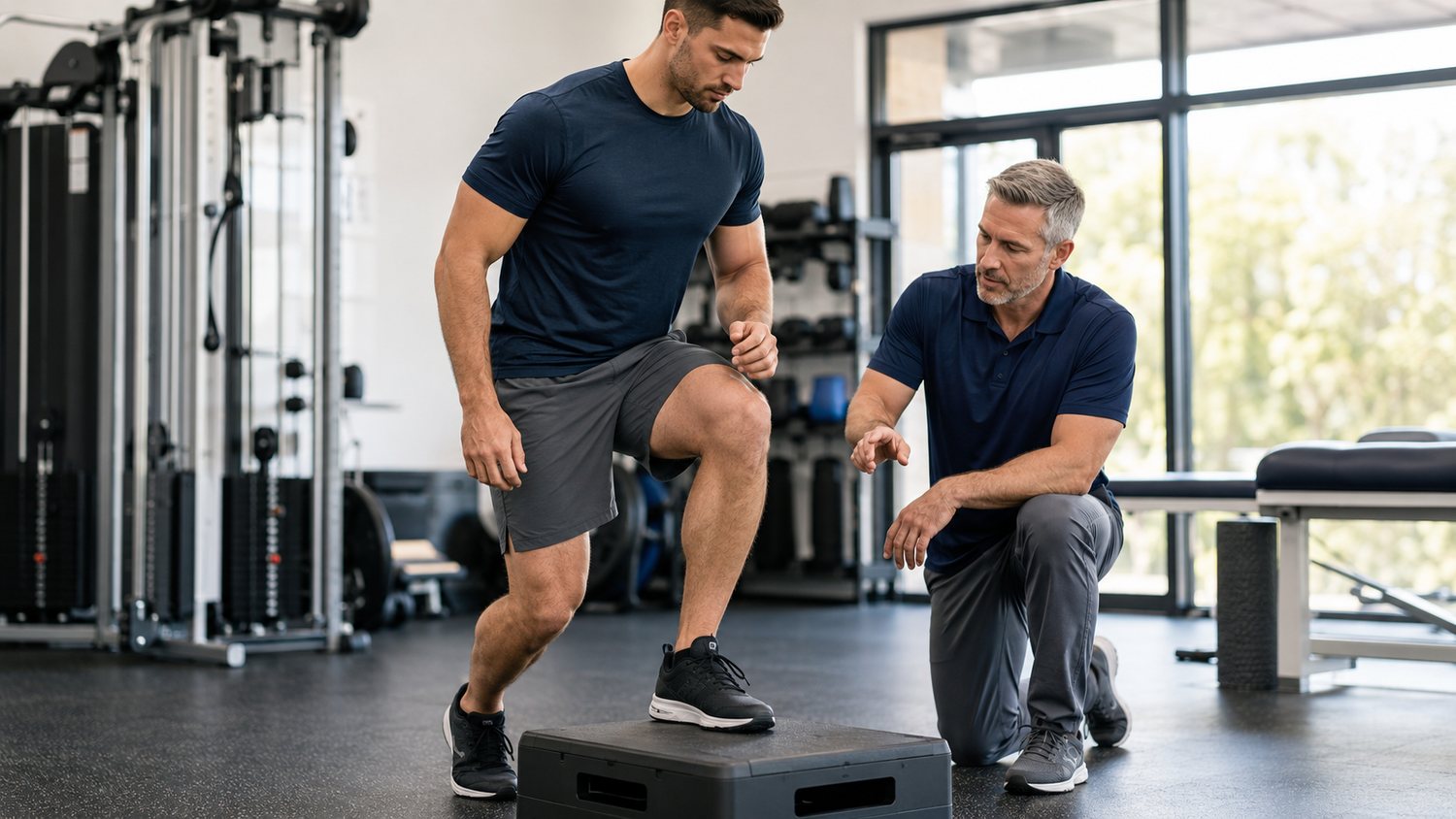
You finish a workout feeling accomplished. Then the next morning, getting out of bed feels like its own training session.
Muscle soreness after a new or demanding workout can be a normal response to exercise. But pain is information, and not every ache should be treated as proof that the workout “worked.” The useful question is not simply “Does it hurt?” It is “How does it hurt, when did it begin, and what is it doing over time?”
This guide can help you organize those clues. It cannot tell you whether you have an injury.
What normal soreness often feels like
Common post-workout soreness is usually felt in the muscles you trained. It may feel like tenderness, stiffness, heaviness, or a broad ache on both sides of the body. It often becomes noticeable after the workout rather than during one exact movement.
Normal soreness should remain manageable. You may move a little stiffly, but you can generally complete ordinary daily activities. Most importantly, the overall trend should move in the right direction.
Ask yourself:
- Is the sensation spread through a muscle rather than concentrated in one precise spot?
- Did it appear after an unfamiliar exercise, a harder session, or a return after time away?
- Does gentle movement help you loosen up?
- Is it gradually improving rather than becoming sharper or more limiting?
No single answer proves that the sensation is harmless. Together, however, these details create a more useful picture than a pain score alone.
Signs that deserve more caution
Pause the workout and consider professional guidance when pain is sharp, sudden, highly localized, or associated with a specific incident. Swelling, significant bruising, weakness, numbness, tingling, a joint that gives way, or an inability to use the area normally are also reasons not to “test it” with another hard session.
Pain that worsens with each workout, changes your gait or technique, wakes you at night, or keeps returning in the same place deserves attention. Frequent pain associated with activity can sometimes represent an overuse problem rather than ordinary soreness.
Seek urgent care for a serious deformity, inability to bear weight after an injury, loss of feeling or movement, severe unexplained weakness, chest pain, trouble breathing, or concerning symptoms after a head impact.
What to do today
If the sensation seems consistent with ordinary soreness and no warning signs are present:
- Reduce the demand. Choose an easier session, train a different area, or take a recovery day.
- Keep movement comfortable. Gentle walking or easy mobility may feel better than complete inactivity.
- Watch the trend. Note whether function and comfort improve over the next few days.
- Review the trigger. A sudden jump in weight, volume, intensity, frequency, terrain, or a new exercise may explain why this session hit differently.
- Do not use pain relief to override a warning signal. If you need medication simply to complete the planned workout, reconsider the workout first.
The next-workout check
Before you train again, try the movement at low effort. Can you move through the normal pattern without sharp pain, compensation, or increasing symptoms? If not, change the plan.
The goal is not to prove toughness. It is to preserve enough capacity to train consistently.
Bottom line
Broad, manageable muscle soreness that follows an unfamiliar workload and steadily improves is different from pain that is sharp, localized, worsening, or function-limiting. When the pattern is unclear, the safer move is to reduce the load and reassess—not force the original plan.
Continue your pathway
- Pain keeps returning? Read Why Does the Same Pain Keep Coming Back?
- Deciding about today’s session? Read Should I Work Out When Something Hurts?
- Symptoms are limiting normal activity? Read When Is It Time to Get an Injury Checked?
FAQ
Is it normal to be sore two days after a workout?
Soreness can be delayed after a new or demanding session. What matters is the full pattern: the sensation should be manageable and should begin improving. Sharp, worsening, highly localized, or function-limiting pain deserves more caution.
Should I stretch sore muscles?
Gentle, comfortable mobility may help you feel less stiff. Avoid forcing a deep stretch into pain, particularly if you suspect a strain or another injury.
Can I work out when I am sore?
Sometimes. Consider reducing intensity, shortening the session, or training a different area. Stop if pain becomes sharp, your movement changes, or symptoms increase.
Editorial sources
- [MedlinePlus: How to avoid exercise injuries](https://medlineplus.gov/ency/patientinstructions/000859.htm)
- [AAOS: Hip Strains](https://orthoinfo.aaos.org/diseases--conditions/hip-strains/)
- [MedlinePlus: Muscle Aches](https://medlineplus.gov/ency/article/003178.htm)