“Take it easy” is vague. “Listen to your body” is useful only if you know what to change.
Workout modification means reducing or redirecting the demand that appears to aggravate symptoms while preserving activity that remains comfortable and controlled. It is not a diagnosis or a universal rehabilitation plan. It is a practical way to stop treating every workout as all-or-nothing.
Change one variable at a time
When possible, adjust one major variable so you can understand the response.
1. Reduce load
Use less weight, assistance, or a lighter resistance setting. A lifter might swap a heavy working set for a controlled technique session.
2. Shorten the range of motion
Work only through a comfortable range without forcing the painful portion. Do not assume a limited range is appropriate for every injury; it is simply one temporary way to lower demand.
3. Slow down
Reduce running pace, cycling resistance, throwing speed, or the urgency of a circuit. Slower movement can improve control, although it may increase muscular demand in some strength exercises.
4. Reduce impact or complexity
Trade jumping for a grounded movement, running for easy cycling, or a dynamic balance exercise for a supported variation. Choose an option with a lower consequence if your control fails.
5. Shorten the session
Reduce total sets, repetitions, distance, or time. Fatigue often changes technique and tolerance, so stopping earlier can matter as much as reducing intensity.
Use a three-part response check
A modification is useful only if the response supports it.
- During the session: Symptoms stay mild and stable, and mechanics remain normal.
- After the session: There is no significant escalation.
- The next day: You are at or near the previous baseline rather than dealing with a larger flare.
If symptoms increase at any checkpoint, reduce the demand further or stop. If even easy activity is provoking symptoms, or the pattern keeps returning, seek an assessment.
Examples for everyday athletes
Strength training
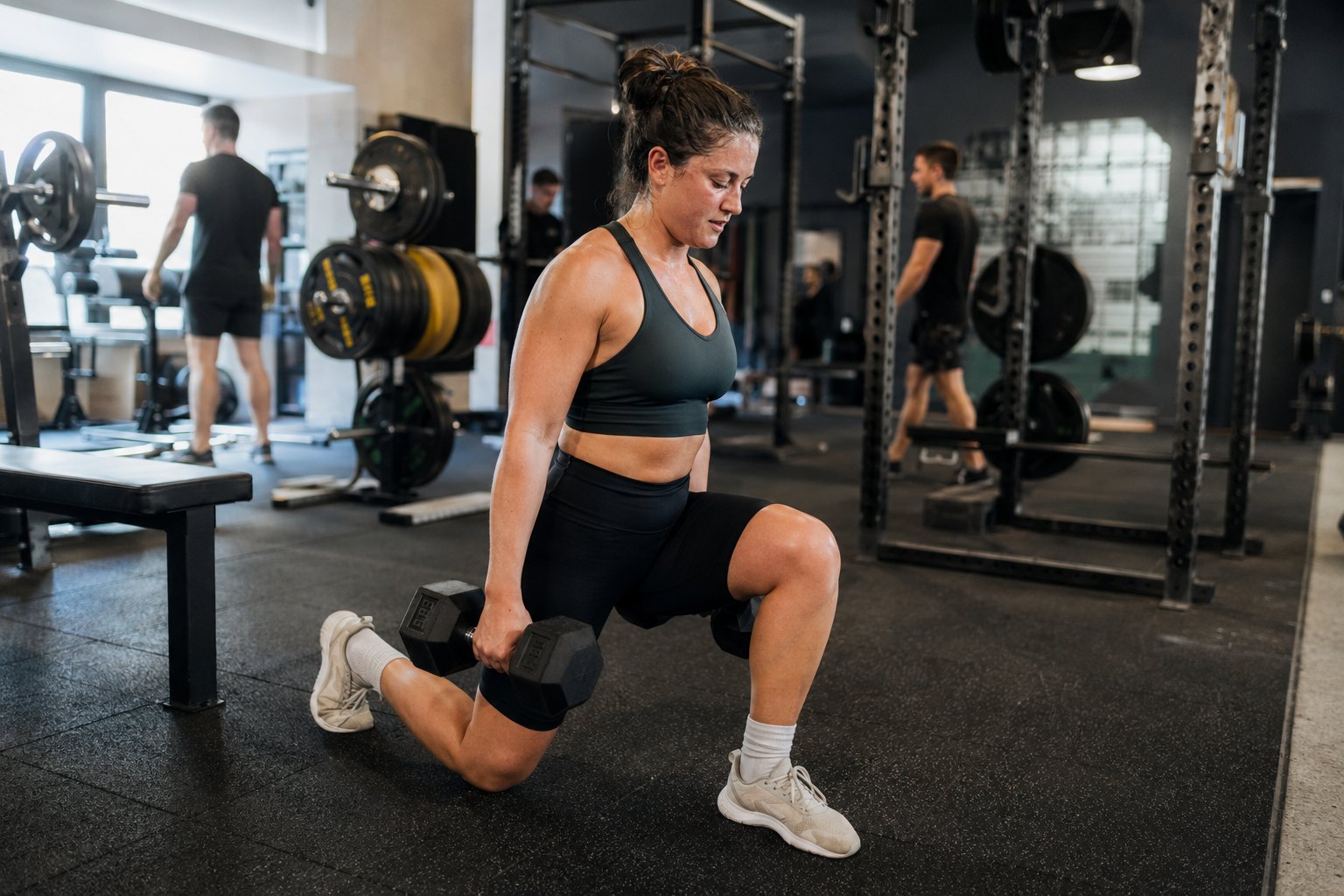
Replace a painful loaded lunge with a supported split stance, a shallower comfortable range, or a different lower-body movement. Reduce weight before adding repetitions.
Running
Change a speed session to a shorter walk-run on level ground, or choose comfortable low-impact conditioning. Avoid changing shoes, terrain, distance, and pace all at once.
Cycling or spin
Reduce resistance and time, and check whether the bike setup is contributing to the pattern. Stop if pain increases with each pedal stroke.
Court and field sports
Replace full games with controlled drills that reduce cutting, acceleration, or contact. If the joint feels unstable or gives way, stop and get it assessed.
Yoga or group fitness
Use props, reduce depth, and skip positions that reproduce sharp or escalating pain. Do not let the pace of the class make the decision for you.
Modification is a bridge
Modification can help you stay active while symptoms settle or while you arrange care. It should not become a permanent workaround for a worsening problem.
Set a review point. If the same change is still necessary after a reasonable interval, symptoms are appearing earlier, or your available activity keeps shrinking, involve a qualified professional.
Bottom line
Modify load, range, speed, impact, complexity, or duration—and then evaluate the response. The best modification is not the one that lets you finish at any cost. It is the one that keeps movement controlled without making the pattern worse.
Continue your pathway
- Need help deciding whether to train? Read Should I Work Out When Something Hurts?
- Modification is not solving it? Read Why Does the Same Pain Keep Coming Back?
- Ready for an assessment? Read When Is It Time to Get an Injury Checked?
FAQ
Is modifying a workout the same as rehabilitation?
No. Modification changes the immediate training demand. Rehabilitation is an individualized process designed to restore function and capacity, often with professional guidance.
How much should I reduce my workout?
There is no universal percentage. Reduce the demand enough that symptoms remain stable, movement remains normal, and you do not experience a meaningful flare afterward.
What if every variation still hurts?
Stop the aggravating activity. If pain is significant, recurring, worsening, or affecting normal function, arrange an assessment.
Editorial sources
- [AAOS: Shin Splints](https://orthoinfo.aaos.org/en/diseases--conditions/shin-splints/)
- [AAOS: Hip Strains](https://orthoinfo.aaos.org/diseases--conditions/hip-strains/)
- [MedlinePlus: How to avoid exercise injuries](https://medlineplus.gov/ency/patientinstructions/000859.htm)